
The Dink (2026) ending explained: Does Dusty Boyd defeat Andy Roddick and finally get together with Candace?
Sinthya Banik | Jul 24, 2026, 23:00 IST
The Dink follows a washed-up tennis coach forced into pickleball to save his father’s club, exploring failed ambition, unexpected friendship and the quiet fight for personal respect.

Image credit : Apple TV Press| Dusty Boyd faces Andy Roddick in a decisive pickleball showdown and his father’s respect hang in the balance at the end of The Dink
The Dink is a 2026 Apple TV sports comedy that takes the rising tension between tennis and pickleball and turns it into a light underdog story with real heart. Directed by Josh Greenbaum, the filmmaker behind Barb and Star Go to Vista Del Mar, and written by Sean Clements of Workaholics and the Hollywood Handbook podcast, the film comes from producer Ben Stiller’s Red Hour Films. It premiered on Apple TV on July 24, 2026.
Jake Johnson stars as Dusty Boyd, a washed-up former tennis prodigy nicknamed “The Hammer” who now coaches kids at his father’s club. Ed Harris plays Chuck Boyd, the hard-edged club owner and Dusty’s demanding father. Mary Steenburgen is Candace, the divorced pickleball player who becomes Dusty’s unlikely partner. Supporting turns come from Aaron Chen as Dusty’s loyal but awkward assistant PJ, Ben Stiller as the eccentric doctor, Patton Oswalt as a pickleball advocate, and real tennis stars Andy Roddick and John McEnroe playing versions of themselves.
At just under two hours, the movie mixes broad sports comedy with quieter moments about approval, failure and learning to enjoy a game without the weight of expectation.
Dusty Boyd opens the film the same way he starts most of his days at Mountain Crest Country Club. He stands on a tennis court with a small group of children who look like they would rather be anywhere else. He is mid-story, gesturing with a racket, describing the glory days when people called him The Hammer. PJ, his only real friend and the club’s unofficial assistant, stands just off to the side and fills in the applause that never comes from the kids.
Dusty still drives a car with vanity plates that read DE-HAMMR. He still refers to himself in the third person when the mood hits. The children stare at their shoes. Chuck, his father and the owner of the club, watches from a distance with the expression of a man who has heard this particular story too many times and never liked the ending.
The flashbacks arrive in pieces. Chuck trained Dusty hard from a young age. The boy had a heavy, punishing serve that earned him the nickname. He collected junior titles. The match against a young Andy Roddick was supposed to be the doorway to the professional circuit. Dusty has spent years telling a cleaned-up version of what happened. In his version Roddick left a spill on the bathroom floor. Dusty slipped and the wrist shattered. The truth is more uncomfortable and more revealing.
Overwhelmed and already unsure whether he even liked the sport, Dusty asked for a break, went into the bathroom, and deliberately struck his own wrist with the racket so he could quit. He never recovered the trajectory. He never went pro. He returned to Mountain Crest and started coaching under the same father who still saw the injury as a lack of fight rather than a quiet moment of surrender.
That unresolved disappointment sits between them like a permanent net. Dusty keeps performing the old stories because they are the only version of himself that still gets any reaction at all. Chuck keeps the club running with rigid standards and open contempt for anything that feels less pure than traditional tennis. When pickleball first appears at Mountain Crest, Dusty sides with his father without thinking twice.
An errant ball lands on his court during a lesson. Candace walks over to retrieve it. Dusty insults her, declares the club is for tennis only, and bans her on the spot. The ban is pure ego. Chuck immediately undercuts him. Dusty has no real authority to ban anyone. The moment is small but it lands hard. Dusty is still trying to claim power he does not have, and Chuck is still reminding him of the hierarchy that has never changed.
Chuck calls pickleball “the novel coronavirus of sports” and “the decline of humanity itself.” A group of members, led by an advocate named Skip, begins pushing for more court space. Chuck has already conceded one poorly maintained court as a token gesture. The surface is cracked. The fence is unreliable and a leak leaves one corner permanently damp. When the board prepares to vote on converting additional tennis courts, Chuck digs up an old club charter. The document allows him to replace a democratic vote with a formal duel. The winner of a match between representatives of tennis and pickleball will decide the future allocation of courts.
Dusty assumes he will be chosen to represent tennis. The chance to stand up for his father and finally prove himself feels like the redemption he has waited for most of his adult life. Chuck selects someone else. Then Dusty aggravates the old wrist injury during a fall on the court. The injury is serious enough that tennis is off the table for the near future. His doctor, played by Ben Stiller with a running series of inappropriate comments and a general lack of professional boundaries, tells him the fastest way to recover is low-impact movement that still keeps the joint active. The prescription is pickleball.
Dusty shows up at a public court still full of resentment. He runs into Candace again. She is there with her regular partners, including Gail and Judy. They need a fourth. Dusty reluctantly steps in. The first few points feel wrong in every way. He tries to muscle the ball the way he used to in tennis. Candace stops him mid-swing more than once and explains the kitchen rules, the soft dink, the value of placement over power. Something unexpected happens. Dusty starts to enjoy the slower rhythm. He keeps coming back. PJ tags along and becomes part of the group. The same man who once banned Candace is now learning the game he called a joke, and the people around him treat him with more patience than his own father ever did.
Back at Mountain Crest the pressure increases. Chuck’s first-choice tennis player dies in an accident. The path opens for Dusty again. By then his loyalties have shifted in ways he has not fully admitted to himself. The people on the pickleball side have given him something the tennis side never did. Dusty decides to represent pickleball instead. Chuck answers by bringing in Andy Roddick. The childhood rival who once ended Dusty’s career is now standing on the other side of the net as the official face of tennis at the club. The duel is no longer abstract. It is personal, and it is public.
Their first meeting is pure hostility. Candace is polite and matter-of-fact. Dusty is neither. The ban is petty and unnecessary, the kind of small power play that reveals more about the person making it than the person receiving it. Weeks later the dynamic has flipped completely. Candace becomes Dusty’s regular partner at the public courts. She notices when he reverts to old tennis habits and corrects him without turning it into a lecture. She talks about her divorce in plain terms. Her ex has already moved on. She is tired of people who only show up when it is convenient for them. Dusty, for the first time in years, starts showing up in ways that actually matter.
He learns the soft game. He listens to the country music she likes even though he hates it. He attends her ex-husband’s charity event as her younger “boyfriend” for the evening, playing the part with awkward sincerity and a visible desire to get it right.
The chemistry between Johnson and Steenburgen is easy and specific. The age gap is never treated as a punchline or a gimmick. Dusty misreads the closeness. After the event he leans in for a kiss. Candace stops him cleanly and without cruelty. She likes him. She values the friendship. But she is not looking for a romance, especially not with someone still sorting out his own life and still half-defined by his father’s opinion of him. Dusty takes the rejection without turning it into another performance of wounded pride. That choice is one of the more honest moments in the film. It shows he is capable of growth that does not require an audience.
![Screenshot 2026-07-24 at 10]()
By the time the final match approaches, Candace and her friends have become Dusty’s actual support system. They help him locate the club rule that lets the winner of the coin toss choose the court. The relationship settles into something steady and useful. No late-stage reversal. No forced pairing at the credits. Just two people who found each other at the right moment for friendship and stayed there without needing it to become something else.
Dusty wins the coin toss. He chooses the neglected pickleball court at Mountain Crest. The decision is strategic and a little pointed. The surface is cracked. The fence is unreliable. The persistent leak still leaves one corner slippery. Roddick arrives treating the match as a lesser version of tennis, the kind of game you can pick up in an afternoon if you already know how to hit a ball. He adapts quickly and takes an early lead with hard, clean shots.
Dusty stays patient in a way the old Hammer never could. He keeps the ball in the kitchen and steers points toward the damaged areas of the court that Chuck has ignored for years. Roddick crashes into the fence. He slips near the wet spot. Dusty takes the match with a soft final dink that feels almost gentle after everything that led up to it.
The win locks in more pickleball courts at the club. Tennis does not disappear. Six months later Mountain Crest hosts its first proper pickleball tournament while the tennis courts continue as usual. The two sports coexist without one having to erase the other. Dusty is there, no longer performing the old Hammer stories for anyone who will listen, simply playing a game he enjoys with people who do not need him to be a former prodigy.
![Screenshot 2026-07-24 at 10]()
Chuck watches the match and then walks into his office and cries. Later he tells Dusty he is proud. The approval arrives, but it arrives after Dusty has already stopped needing it in the same desperate way. He has a game that does not require his father’s permission. He has friends who do not measure him by junior titles or by the version of the Roddick match that never quite matched reality. The father-son relationship is not magically fixed. Chuck’s pride comes late and still carries the weight of years of conditional affection. But both men are a little less rigid than they were at the start of the story.
So the answers are clear and final. Yes, Dusty Boyd defeats Andy Roddick. No, he does not end up in a romantic relationship with Candace. They remain close friends. The real victory is quieter than the final score and more lasting. Dusty stops living inside the version of himself that existed only to impress his father and finds a version that can stand on its own, racket in hand, without needing the old stories to keep him upright.
The Dink is streaming now on Apple TV.
Jake Johnson stars as Dusty Boyd, a washed-up former tennis prodigy nicknamed “The Hammer” who now coaches kids at his father’s club. Ed Harris plays Chuck Boyd, the hard-edged club owner and Dusty’s demanding father. Mary Steenburgen is Candace, the divorced pickleball player who becomes Dusty’s unlikely partner. Supporting turns come from Aaron Chen as Dusty’s loyal but awkward assistant PJ, Ben Stiller as the eccentric doctor, Patton Oswalt as a pickleball advocate, and real tennis stars Andy Roddick and John McEnroe playing versions of themselves.
At just under two hours, the movie mixes broad sports comedy with quieter moments about approval, failure and learning to enjoy a game without the weight of expectation.
The Hammer who never quite made it
Dusty still drives a car with vanity plates that read DE-HAMMR. He still refers to himself in the third person when the mood hits. The children stare at their shoes. Chuck, his father and the owner of the club, watches from a distance with the expression of a man who has heard this particular story too many times and never liked the ending.
The flashbacks arrive in pieces. Chuck trained Dusty hard from a young age. The boy had a heavy, punishing serve that earned him the nickname. He collected junior titles. The match against a young Andy Roddick was supposed to be the doorway to the professional circuit. Dusty has spent years telling a cleaned-up version of what happened. In his version Roddick left a spill on the bathroom floor. Dusty slipped and the wrist shattered. The truth is more uncomfortable and more revealing.
Overwhelmed and already unsure whether he even liked the sport, Dusty asked for a break, went into the bathroom, and deliberately struck his own wrist with the racket so he could quit. He never recovered the trajectory. He never went pro. He returned to Mountain Crest and started coaching under the same father who still saw the injury as a lack of fight rather than a quiet moment of surrender.
That unresolved disappointment sits between them like a permanent net. Dusty keeps performing the old stories because they are the only version of himself that still gets any reaction at all. Chuck keeps the club running with rigid standards and open contempt for anything that feels less pure than traditional tennis. When pickleball first appears at Mountain Crest, Dusty sides with his father without thinking twice.
An errant ball lands on his court during a lesson. Candace walks over to retrieve it. Dusty insults her, declares the club is for tennis only, and bans her on the spot. The ban is pure ego. Chuck immediately undercuts him. Dusty has no real authority to ban anyone. The moment is small but it lands hard. Dusty is still trying to claim power he does not have, and Chuck is still reminding him of the hierarchy that has never changed.
Pickleball invades the Club and Dusty’s entire sense of self
Dusty assumes he will be chosen to represent tennis. The chance to stand up for his father and finally prove himself feels like the redemption he has waited for most of his adult life. Chuck selects someone else. Then Dusty aggravates the old wrist injury during a fall on the court. The injury is serious enough that tennis is off the table for the near future. His doctor, played by Ben Stiller with a running series of inappropriate comments and a general lack of professional boundaries, tells him the fastest way to recover is low-impact movement that still keeps the joint active. The prescription is pickleball.
Dusty shows up at a public court still full of resentment. He runs into Candace again. She is there with her regular partners, including Gail and Judy. They need a fourth. Dusty reluctantly steps in. The first few points feel wrong in every way. He tries to muscle the ball the way he used to in tennis. Candace stops him mid-swing more than once and explains the kitchen rules, the soft dink, the value of placement over power. Something unexpected happens. Dusty starts to enjoy the slower rhythm. He keeps coming back. PJ tags along and becomes part of the group. The same man who once banned Candace is now learning the game he called a joke, and the people around him treat him with more patience than his own father ever did.
Back at Mountain Crest the pressure increases. Chuck’s first-choice tennis player dies in an accident. The path opens for Dusty again. By then his loyalties have shifted in ways he has not fully admitted to himself. The people on the pickleball side have given him something the tennis side never did. Dusty decides to represent pickleball instead. Chuck answers by bringing in Andy Roddick. The childhood rival who once ended Dusty’s career is now standing on the other side of the net as the official face of tennis at the club. The duel is no longer abstract. It is personal, and it is public.
Candace, the ban and the partnership that quietly changed everything
He learns the soft game. He listens to the country music she likes even though he hates it. He attends her ex-husband’s charity event as her younger “boyfriend” for the evening, playing the part with awkward sincerity and a visible desire to get it right.
The chemistry between Johnson and Steenburgen is easy and specific. The age gap is never treated as a punchline or a gimmick. Dusty misreads the closeness. After the event he leans in for a kiss. Candace stops him cleanly and without cruelty. She likes him. She values the friendship. But she is not looking for a romance, especially not with someone still sorting out his own life and still half-defined by his father’s opinion of him. Dusty takes the rejection without turning it into another performance of wounded pride. That choice is one of the more honest moments in the film. It shows he is capable of growth that does not require an audience.
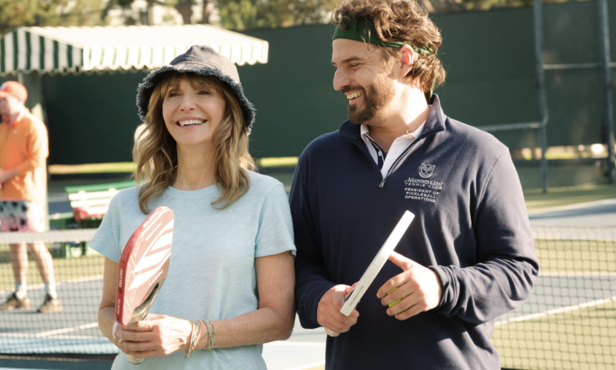
Image credit : Apple TV Press| Mary Steenburgen and Jake Johnson in The Dink
By the time the final match approaches, Candace and her friends have become Dusty’s actual support system. They help him locate the club rule that lets the winner of the coin toss choose the court. The relationship settles into something steady and useful. No late-stage reversal. No forced pairing at the credits. Just two people who found each other at the right moment for friendship and stayed there without needing it to become something else.
The final match against Andy Roddick and what Dusty actually walks away with
Dusty stays patient in a way the old Hammer never could. He keeps the ball in the kitchen and steers points toward the damaged areas of the court that Chuck has ignored for years. Roddick crashes into the fence. He slips near the wet spot. Dusty takes the match with a soft final dink that feels almost gentle after everything that led up to it.
The win locks in more pickleball courts at the club. Tennis does not disappear. Six months later Mountain Crest hosts its first proper pickleball tournament while the tennis courts continue as usual. The two sports coexist without one having to erase the other. Dusty is there, no longer performing the old Hammer stories for anyone who will listen, simply playing a game he enjoys with people who do not need him to be a former prodigy.
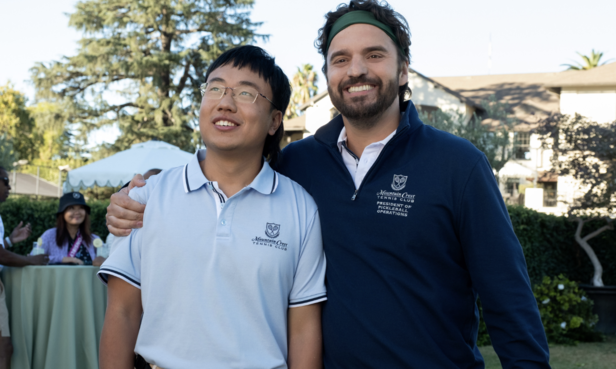
Image credit : Apple TV Press| Aaron Chen and Jake Johnson in The Dink
Chuck watches the match and then walks into his office and cries. Later he tells Dusty he is proud. The approval arrives, but it arrives after Dusty has already stopped needing it in the same desperate way. He has a game that does not require his father’s permission. He has friends who do not measure him by junior titles or by the version of the Roddick match that never quite matched reality. The father-son relationship is not magically fixed. Chuck’s pride comes late and still carries the weight of years of conditional affection. But both men are a little less rigid than they were at the start of the story.
So the answers are clear and final. Yes, Dusty Boyd defeats Andy Roddick. No, he does not end up in a romantic relationship with Candace. They remain close friends. The real victory is quieter than the final score and more lasting. Dusty stops living inside the version of himself that existed only to impress his father and finds a version that can stand on its own, racket in hand, without needing the old stories to keep him upright.
Where to watch The Dink
This shocking true crime story is leaving Netflix viewers speechless
By Nillohit Bagchi

HOTD S3E6 recap: Is [spoiler] dead? A deadly ambush & secrets spilled!
By Sinthya Banik
![HOTD S3E6 recap: Is [spoiler] dead? A deadly ambush & secrets spilled!](https://staticimg.publishstory.co/thumb/132661456.cms?imgsize=2771366&width=72&height=72&resizemode=8 "HOTD S3E6 recap: Is [spoiler] dead? A deadly ambush & secrets spilled!")
Are couples talking less and assuming more than ever before?
By Nancy Jaiswal

Can one deep connection outweigh 100 casual relationships in reality?
By Nancy Jaiswal

Are Gen Z couples dating or just building a couple brand in 2026?
By Nancy Jaiswal

Could future humans be born with just four fingers instead of five?
By Nancy Jaiswal

Gen Z employees are too honest at work; Problem or progress?
By Nancy Jaiswal
