

From FOMO to JOMO: Why Gen Z is romanticising missing out and it's changing everything
Aparna Krishna | Jun 04, 2026, 16:18 IST
From skipping packed schedules and not chasing trends to embracing slow life routines and digital detoxing, young Indians are moving away from fear of missing out to discovering true happiness and finding themselves. They are now setting boundaries and choosing what they genuinely want in their lives.

Image credit : ChatGPT | Gen Z is more into JOMO, Joy Of Missing Out
Anamika Bose, a 19-year-old college student, hurriedly packs her bag late at night. One of her roommates asks where she is going, and Bose excitedly replies that she is heading to the beach for a girls' trip with her friends.
Her roommate looks surprised. “Why are you going? You have a sun allergy, right?”
![]()
“That’s true,” Bose admits, “but I don’t want to feel left out. I don’t want to see my friends’ Instagram feeds filled with photos of them relaxing on the beach while I stay back. They’ll come to college and keep ranting about the trip, and I’ll end up feeling FOMO.”
![From FOMO to JOMO: Why young Indians are moving away from fear of missing out to finally enjoying it?]() For years, this was a familiar situation for many young people. They constantly sought inclusion, even in activities they had no genuine interest in, simply because they feared missing out on experiences, conversations, or memories. The pressure to stay connected and be part of every social moment often remained above personal preference.
For years, this was a familiar situation for many young people. They constantly sought inclusion, even in activities they had no genuine interest in, simply because they feared missing out on experiences, conversations, or memories. The pressure to stay connected and be part of every social moment often remained above personal preference.
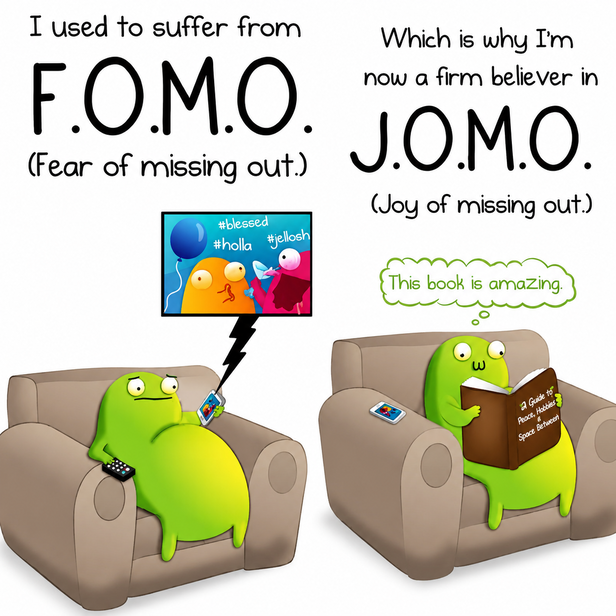
But today, that mindset is beginning to change. People are actually happy to be not involved; people are into JOMO.
JOMO stands for “Joy Of Missing Out.” It is a psychological practice of finding peace, contentment, and happiness by opting out of social activities, social trends, and internet addiction. It includes taking time for yourself without any guilt or regret. JOMO is trending among Gen Z as they prefer self-care, slow life, and are into digital detox.
Gen Z is spending time to find themself and is into reducing stress and pressure. Youngsters are actually into chasing what they actually want rather than what others want or what society wants. Other terms like FOBI and ROMO are also trending online, which stand for Fear Of Being Involved and Relief Of Missing Out, respectively. These terms have the same meaning as that of JOMO.
![From FOMO to JOMO: Why young Indians are moving away from fear of missing out to finally enjoying it?]() After years of being online constantly, many Gen Z as well as millennials are experiencing digital pressure. The pressure to keep up with trends, reply instantly, and document every moment can be exhausting. As a result, more young people are becoming comfortable saying no. No to plans they don't enjoy. No to trends they don't care about. No to the idea that every free moment must be filled.
After years of being online constantly, many Gen Z as well as millennials are experiencing digital pressure. The pressure to keep up with trends, reply instantly, and document every moment can be exhausting. As a result, more young people are becoming comfortable saying no. No to plans they don't enjoy. No to trends they don't care about. No to the idea that every free moment must be filled.
Social media is playing a huge role in this shift. The same platform that fuelled FOMO is fuelling JOMO. These platforms are filled with mental health talks, burnouts, and finding ourself contents. Gen Z is setting screen times and is more into exterior sports, small self-improvement habits, and finding more hobbies. The goal is to stop comparing each other and to grow together.
JOMO isn't about becoming antisocial. It's about being intentional. For a generation that grew up with constant notifications and endless comparison, learning to enjoy what they're doing instead of worrying about what they're missing out may be the biggest thing. And that's why, for many youngsters, missing out has never felt so good. That’s the reason why people are now romanticising JOMO.
Her roommate looks surprised. “Why are you going? You have a sun allergy, right?”

“That’s true,” Bose admits, “but I don’t want to feel left out. I don’t want to see my friends’ Instagram feeds filled with photos of them relaxing on the beach while I stay back. They’ll come to college and keep ranting about the trip, and I’ll end up feeling FOMO.”
But today, that mindset is beginning to change. People are actually happy to be not involved; people are into JOMO.
What is JOMO?
Gen Z is spending time to find themself and is into reducing stress and pressure. Youngsters are actually into chasing what they actually want rather than what others want or what society wants. Other terms like FOBI and ROMO are also trending online, which stand for Fear Of Being Involved and Relief Of Missing Out, respectively. These terms have the same meaning as that of JOMO.
Why is this shift happening?
Role of social media in this trend
JOMO isn't about becoming antisocial. It's about being intentional. For a generation that grew up with constant notifications and endless comparison, learning to enjoy what they're doing instead of worrying about what they're missing out may be the biggest thing. And that's why, for many youngsters, missing out has never felt so good. That’s the reason why people are now romanticising JOMO.

Why fashion is going fully digital
By Saloni Jha

The era of no romance: Is yearning dead in dating?
By Saloni Jha

These books prove LGBTQ stories from Asia hit differently
By Karen Noronha

Trump under pressure: US House passes Iran War resolution — Will Republicans in the Senate follow?
By Nancy Jaiswal

These K-dramas confront loneliness, grief and survival
By Karen Noronha

SpaceX neo cloud strategy: Why Anthropic’s claude is turning to Elon Musk’s colossus data centers for critical AI compute
By Nancy Jaiswal

Erika Kirk UFC Freedom 250 host rumour sparks major fan theories
By Sinthya Banik


